Digital Health Funding: 7 Powerful Signs of a Stunning Boom
Digital health funding just had its loudest opening quarter in years. In the first three months of 2026, startups in the space pulled in $4 billion, the strongest first quarter since the pandemic-era gold rush and a full billion dollars more than the same stretch of 2025. But the headline number hides a stranger story: most of that cash went to a dozen companies. This article breaks down where the digital health money came from, which startups grabbed the biggest checks, and why investors are suddenly writing them again.
How the Digital Health Market Came Roaring Back
For three years the mood in digital health venture circles was cautious. After the 2021 spike, when cheap money and a pandemic pushed valuations to silly heights, the correction was long and quiet. So when the first-quarter 2026 tally landed, it read like a market waking up. The rebound is real, but it is not the broad, everyone-eats boom of 2021. It is narrower, richer, and far more selective about who gets fed.
From Pandemic Peak to a Long, Quiet Correction
Rewind to 2021. Investors threw money at almost anything with a telehealth login screen, and dozens of companies rushed to go public. Then interest rates climbed, the easy capital dried up, and the sector spent 2022 through 2024 digesting the hangover. Deal counts fell. Valuations reset. Plenty of once-hot startups quietly folded or sold for scraps. The market did not collapse, but it stopped being fun.
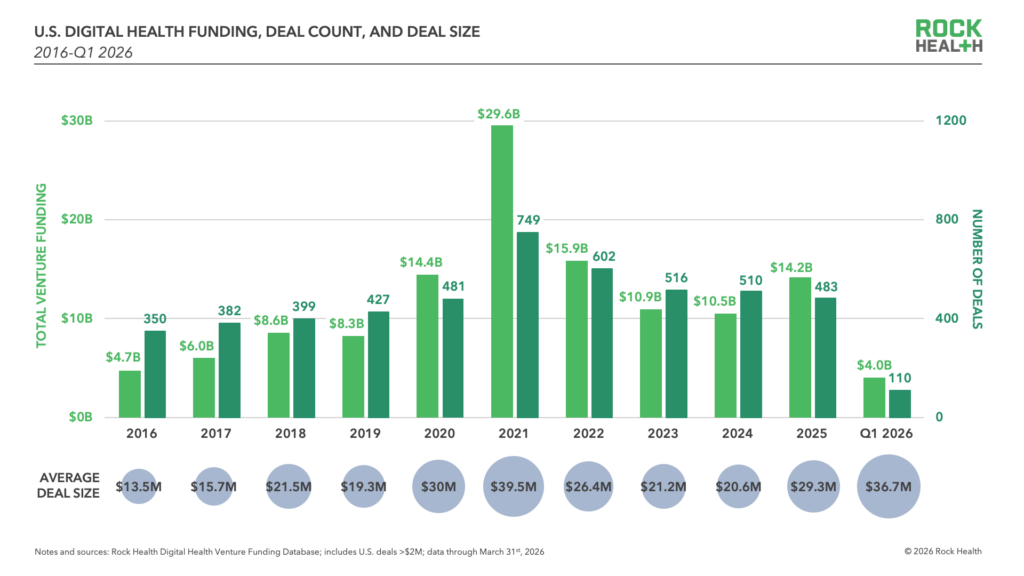
By the close of 2025 the picture had steadied. U.S. digital health startups raised $14.2 billion across the full year, with the fourth quarter alone bringing in $4.2 billion, the best single quarter since mid-2022. The average check had grown to $29.3 million. The recovery was underway; the first quarter of 2026 simply made it impossible to ignore.
The Q1 2026 Numbers That Turned Heads
According to Rock Health, the venture firm that has tracked this market since 2011, the first quarter of 2026 set two records at once. Total funding reached $4.0 billion across 110 deals. The average deal size climbed to $36.7 million, the highest the firm has logged in a single quarter since late 2021. You can read the full Rock Health Q1 2026 breakdown for the underlying data.
Those two digital health figures tell the whole story when you put them together. More money, spread across fewer deals, means bigger individual bets. Investors are not spraying capital across the field anymore. They are concentrating it, placing large sums on companies they believe have already pulled ahead. Rock Health analysts summed up the mood in one line: a market that is active, but selective.
A Billion-Dollar Jump in Twelve Months
The year-over-year gap is what makes the quarter stand out. In the first quarter of 2025, the sector raised $3.0 billion across 122 deals. A year later it raised $4.0 billion across 110. So the industry pulled in a billion dollars more while closing twelve fewer deals. That is a 33% jump in capital paired with a 10% drop in deal count, and it captures the new shape of the market better than any single statistic. As one industry analysis of the Q1 results put it, the megadeals are doing the heavy lifting.
More money moving through fewer hands is the defining pattern of 2026. The sector raised a billion dollars more than a year earlier while closing twelve fewer deals.
Where All the Money Actually Went
If you want to understand this digital health boom, ignore the average and look at the extremes. A small cluster of enormous rounds pulled the whole quarter upward, while the majority of startups competed for what was left. The concentration is the point, so it is worth seeing exactly who won and why.
The Megadeal Machine
Twelve companies, each raising $100 million or more, captured 59% of all the capital deployed in the quarter. That is one of the highest concentrations Rock Health has ever recorded, a hair behind the frenzied levels of early 2021. Strip those twelve rounds out and the remaining 98 companies split roughly $1.6 billion between them, an average closer to $16 million each. The gap between the winners and everyone else is enormous.
The headline round belonged to Whoop, the wearable-fitness maker, which raised $575 million and reached a $10.1 billion valuation, nearly triple its previous mark, on the back of $1.1 billion in annual recurring revenue. The company is reportedly preparing an IPO. Close behind was OpenEvidence, an AI medical search engine now used daily by more than 40% of U.S. physicians, which closed a $250 million round, its third raise in under a year. Other big checks went to Qualified Health ($125 million), Garner Health ($118 million at a $1.35 billion valuation), Cognito Therapeutics ($105 million for an Alzheimer’s device), and Midi Health, whose $100 million round made the women’s midlife-care provider a unicorn.
When AI Stopped Being a Category
For years, Rock Health published a separate line item tracking how much money went to AI startups. This quarter it stopped. The reason is simple: almost every digital health company now describes itself as AI-enabled, so the label no longer sorts anything. In 2025, startups touting AI took 54% of all funding, up from 37% the year before. By 2026 that distinction had dissolved into the background.
The shift shows up on the demand side too. Roughly one in three consumers now uses an AI chatbot for health questions, double the share from a year earlier, and heavyweights like OpenAI and Perplexity have launched health-specific consumer tools that act as a first stop before a doctor visit. Investors are betting that the companies embedding this technology into real clinical workflows, rather than bolting it on for a pitch deck, are the ones that will last.
Haves, Have-Nots, and the Hunt for an Exit
Rock Health has been calling this a market of “haves and have-nots,” and 2026 has deepened the split. Well-capitalized digital health companies with clear revenue attract huge rounds on favorable terms. Everyone else fights for smaller checks under tougher conditions. Raising money is possible, but the bar has risen sharply.
The exit picture stays murky. After Hinge Health and Omada Health broke a long IPO drought in 2025, several strong digital health candidates including Maven Clinic, Included Health, and Aledade are widely expected to test public markets, yet most are choosing to wait out the volatility. As reporting on the funding concentration noted, the public window is open but narrow.
Consolidation has been bumpy too. In March 2026, private equity firm New Mountain Capital’s plan to merge five portfolio companies into a $32 billion AI health platform collapsed over disagreements about debt and governance. For anyone tracking the digital health sector, that failed roll-up was a reminder that big money does not guarantee a smooth deal. For more on the technology reshaping care delivery, see our coverage at Technology Today News and the health technology section (repoint these two internal links to your most relevant posts before publishing).
The window for going public reopened in 2025, but most digital health companies ready for an exit are still choosing patience over a risky debut in a choppy market.
Frequently Asked Questions
How much did digital health startups raise in early 2026?
U.S. startups in the sector raised $4.0 billion across 110 deals in the first quarter of 2026, according to Rock Health. That was the strongest opening quarter since the pandemic-era peak and a full billion dollars higher than the $3.0 billion raised in the same quarter of 2025, even though the number of deals fell from 122 to 110.
Why is the funding concentrated in so few companies?
Just 12 mega-deals of $100 million or more accounted for 59% of all capital in the quarter. Investors are placing large bets on digital health companies with proven revenue and defensible AI-driven products, rather than spreading money thinly. Remove those 12 rounds and the other 98 companies shared only about $1.6 billion, roughly $16 million each.
Which startups raised the biggest rounds?
Wearable maker Whoop led with a $575 million round at a $10.1 billion valuation. AI medical search engine OpenEvidence raised $250 million, and Garner Health took $118 million at a $1.35 billion valuation. Qualified Health, Cognito Therapeutics, and Midi Health each raised $100 million or more, with Midi reaching unicorn status.
Conclusion
The 2026 rebound is genuine, but it rewards a narrow set of winners. Capital is flowing again, valuations are climbing, and AI has become the assumed baseline rather than a selling point. Yet the same forces concentrating money at the top are squeezing everyone else and keeping the exit door only half open. Whether this becomes a durable digital health expansion or another short-lived spike depends on what the next few quarters bring. If you are building, investing, or just watching the digital health space, keep an eye on whether Q2 sustains this pace or the megadeal engine finally cools.