
Top Cybersecurity Trends 2026: Ultimate AI & Zero Trust Guide
Over 60% of organizations worldwide expect a major cyberattack within the next 12 months, making Top Cybersecurity Trends 2026 essential knowledge for every IT leader and business owner. The threat landscape is evolving faster than ever, fueled by artificial intelligence weaponization, expanding attack surfaces, and the looming reality of quantum computing. Whether you manage enterprise infrastructure or run a growing startup, understanding these shifts is the difference between resilience and catastrophe.
This guide delivers a comprehensive breakdown of the two most critical cybersecurity movements shaping 2026: AI-driven defense systems and Zero Trust architecture combined with quantum-safe security. You will gain actionable strategies, real-world examples, and practical frameworks to protect your organization. Let’s dive into the full roadmap below.
Table of Contents
AI-Driven Cybersecurity Trends 2026 Reshaping Defense
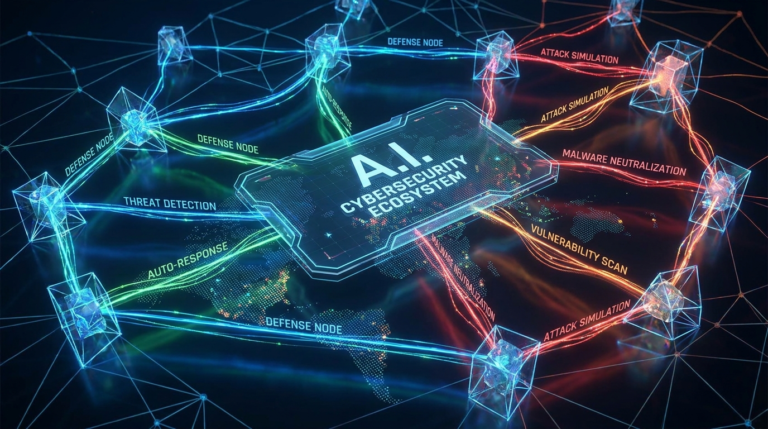
Among the Top Cybersecurity Trends 2026, artificial intelligence stands as the most transformative force in both offense and defense. AI-driven cybersecurity trends 2026 are redefining how organizations detect, respond to, and prevent attacks at machine speed. According to Cisco’s 2026 State of AI Security Report, 85% of security teams now rely on AI-powered tools for at least one critical function in their security operations center.
The shift is not optional. Attackers are already leveraging generative AI to craft convincing phishing emails, automate vulnerability scanning, and develop polymorphic malware that evades traditional signature-based detection. Defenders must match this pace or fall behind. The sections below explore two pivotal dimensions of AI in cybersecurity: agentic AI for proactive defense and the growing risk of shadow AI.
How Agentic AI Detects Threats in Real Time
Agentic AI refers to autonomous AI systems that can independently make decisions, take actions, and adapt without waiting for human instructions. Unlike traditional security automation that follows rigid playbooks, agentic AI evaluates context, prioritizes threats, and executes responses in milliseconds.
Here is how agentic AI is being deployed in real-world security operations:
- Autonomous threat hunting: AI agents continuously scan network traffic, endpoint behavior, and log data to identify anomalies before they escalate.
- Dynamic incident response: When a breach is detected, agentic AI isolates compromised endpoints, revokes credentials, and initiates forensic analysis simultaneously.
- UEBA integration: User and Entity Behavior Analytics (UEBA) is a technique that profiles normal behavior patterns to flag deviations. Agentic AI enhances UEBA by learning and adapting baselines in real time.
- Predictive vulnerability management: AI models analyze patch histories, exploit databases, and dark web intelligence to predict which vulnerabilities attackers will target next.
A practical example comes from a mid-sized financial services firm in Singapore. In early 2025, the firm deployed an agentic AI platform across its SOC. Within three months, mean time to detect threats dropped from 48 hours to under 15 minutes. The system autonomously blocked 12 credential-stuffing attacks that previously required manual analyst intervention.
The key advantage is speed. Human analysts remain essential for strategic decisions, but agentic AI handles the volume and velocity of modern attacks that no human team can match alone. Organizations investing in this technology gain a measurable defensive edge heading into 2026.
Managing Shadow AI and Emerging Attack Vectors
Shadow AI describes the unauthorized use of AI tools and models by employees without IT department approval or oversight. This phenomenon has exploded as generative AI tools became freely accessible. Employees use unapproved AI chatbots for coding, data analysis, and customer communication, often feeding sensitive corporate data into external systems.
The security risks of shadow AI include:
- Data leakage: Proprietary code, financial data, and customer records sent to third-party AI platforms without encryption or access controls.
- Model poisoning: Attackers compromise public AI tools that employees rely on, injecting malicious outputs that influence business decisions.
- Compliance violations: Untracked AI usage can violate GDPR, HIPAA, and emerging AI-specific regulations like the EU AI Act.
- Supply chain risks: AI plugins and integrations introduce unvetted code into enterprise environments.
Consider a real case from a European healthcare provider. In late 2024, a radiology department used an unapproved AI diagnostic tool that stored patient scans on a cloud server outside EU jurisdiction. The resulting GDPR investigation cost the organization over €2 million in fines and remediation. This situation is exactly what shadow AI governance aims to prevent.
To combat shadow AI, security leaders should implement these controls:
- Deploy AI discovery tools that monitor network traffic for unauthorized AI API calls.
- Establish an approved AI tool registry with clear usage policies.
- Integrate AI usage monitoring into existing Data Loss Prevention (DLP) systems.
- Conduct quarterly shadow AI audits across all departments.
Budgeting for shadow AI governance is a growing line item. Industry estimates suggest organizations should allocate 5–8% of their cybersecurity budget to AI governance in 2026. The ROI is clear: preventing a single data breach saves an average of $4.45 million according to IBM’s annual cost of breach reports. For more insights on how AI is reshaping digital platforms, explore how AI is transforming digital ticketing systems.

Zero Trust and Quantum-Safe Top Cybersecurity Trends 2026
The second pillar of Top Cybersecurity Trends 2026 combines Zero Trust architecture with quantum-safe security, two frameworks converging to form the backbone of modern enterprise defense. Zero Trust architecture trends 2026 reflect a fundamental shift: organizations no longer assume any user, device, or network segment is inherently trustworthy. As detailed by Seraphic Security’s analysis of leading Zero Trust frameworks, adoption rates have surged past 70% among enterprises with more than 1,000 employees.
Simultaneously, quantum computing advances are forcing a rethinking of encryption standards. Organizations that ignore quantum readiness today risk having their encrypted data harvested now and decrypted later, a strategy known as “harvest now, decrypt later.” Below we examine both dimensions in detail.
Building Identity-First Zero Trust Frameworks
Identity-first architecture is a security design philosophy where user and device identity serves as the primary control plane for all access decisions. In traditional perimeter-based security, a firewall protected the network boundary. Zero Trust eliminates that concept entirely. Every access request is verified regardless of origin.
The core principles of a Zero Trust framework in 2026 include:
| Principle | Description | Implementation Tool |
|---|---|---|
| Verify Explicitly | Authenticate and authorize every request using all available data points | Multi-factor authentication, conditional access policies |
| Least Privilege Access | Grant only the minimum permissions needed for each task | Just-in-time access, role-based access control (RBAC) |
| Assume Breach | Design systems as if attackers are already inside the network | Micro-segmentation, continuous monitoring |
| Continuous Validation | Re-evaluate trust at every stage, not just at login | Session risk scoring, behavioral analytics |
A compelling real-world example is a U.S. federal agency that completed its Zero Trust migration in 2025 under Executive Order 14028 mandates. The agency replaced its VPN-centric model with identity-aware proxies and micro-segmented its network into over 200 zones. After deployment, lateral movement attempts by red team testers dropped by 94%.
For small and mid-sized businesses, implementing Zero Trust does not require a massive budget. Practical first steps include:
- Enable multi-factor authentication across all accounts, especially privileged ones.
- Implement single sign-on (SSO) tied to a centralized identity provider.
- Segment critical databases and applications from general network traffic.
- Deploy endpoint detection and response (EDR) on all company devices.
- Audit third-party vendor access quarterly and revoke dormant permissions.
The integration challenge between AI and Zero Trust deserves attention. Organizations deploying AI-driven access decisions must ensure the AI models themselves are secured against adversarial manipulation. A compromised AI model granting access could undermine the entire Zero Trust framework. This intersection is where compliance requirements under frameworks like NIST 800-207 become critical. Understanding how digital platforms manage security is also relevant; see how major platforms are tightening account security policies.
Preparing for Quantum-Ready Encryption Standards
Quantum-ready encryption, also called post-quantum cryptography (PQC), refers to cryptographic algorithms designed to resist attacks from both classical and quantum computers. Current widely used encryption methods like RSA-2048 and ECC could be broken by a sufficiently powerful quantum computer running Shor’s algorithm.
The timeline is closer than many realize. Key milestones include:
- 2024: NIST finalized its first three post-quantum cryptographic standards: ML-KEM, ML-DSA, and SLH-DSA.
- 2025: Major cloud providers began offering PQC options for TLS connections and data-at-rest encryption.
- 2026: Regulatory bodies in the EU and U.S. are expected to mandate PQC transition plans for critical infrastructure sectors.
- 2030: The projected deadline by which most experts believe cryptographically relevant quantum computers could exist.
A real-world example illustrates urgency. A European banking consortium initiated its quantum readiness assessment in mid-2025. The assessment revealed that 40% of their encrypted data archives used RSA-2048, potentially vulnerable to future quantum decryption. Their transition plan spans 18 months and involves migrating to hybrid encryption that combines classical AES-256 with lattice-based PQC algorithms.
Organizations preparing for quantum-safe security should take these steps now:
- Conduct a cryptographic inventory to identify all encryption algorithms currently in use.
- Prioritize high-value, long-lifespan data for early migration to PQC standards.
- Test NIST-approved PQC algorithms in non-production environments.
- Engage vendors about their quantum readiness roadmaps for hardware and software products.
- Budget for a 2–3 year transition period with dedicated resources.
The ROI of early quantum preparation is significant. Organizations that begin now spread costs over multiple budget cycles and avoid emergency migrations. According to EC-Council University’s cybersecurity trends analysis, companies that delay PQC adoption beyond 2027 face estimated transition costs three to five times higher than early adopters. Regional differences also matter; Asia-Pacific organizations are currently leading in PQC pilot programs, while North American firms lead in Zero Trust maturity. For related insights on regional technology adoption patterns, read about technology solutions transforming industries in Latin America.
Frequently Asked Questions
What are the Top Cybersecurity Trends 2026 every business should know?
The most critical trends include AI-driven threat detection using agentic AI, Zero Trust architecture with identity-first design, quantum-safe encryption adoption, shadow AI governance, and continuous behavioral analytics. Every organization regardless of size should evaluate these areas and develop a phased implementation plan aligned with their risk profile and budget for 2026.
How does Zero Trust architecture differ from traditional perimeter security?
Traditional perimeter security trusts everything inside the network firewall. Zero Trust assumes no user or device is trustworthy by default. Every access request is verified using identity, device health, location, and behavioral signals. This approach eliminates lateral movement opportunities and significantly reduces breach impact even when attackers penetrate initial defenses.
Is quantum computing a real threat to current encryption?
Yes, though not immediately. Experts project cryptographically relevant quantum computers could emerge by 2030. The immediate risk is “harvest now, decrypt later” attacks where adversaries collect encrypted data today to decrypt once quantum capability exists. Organizations handling sensitive long-lifespan data should begin transitioning to NIST-approved post-quantum algorithms now.
What is shadow AI and why is it dangerous?
Shadow AI is the unauthorized use of AI tools by employees without IT approval. It creates data leakage risks when sensitive information is fed into unvetted external AI platforms. It also introduces compliance violations, supply chain vulnerabilities, and potential model poisoning attacks. Organizations need AI discovery tools and clear governance policies to manage this growing threat.
How much should organizations budget for cybersecurity in 2026?
Industry benchmarks suggest allocating 10–15% of overall IT budgets to cybersecurity. Within that allocation, emerging areas like AI governance should receive 5–8%, Zero Trust implementation 15–20%, and quantum readiness planning 3–5%. Actual amounts vary by industry, regulatory requirements, and organizational risk tolerance. Starting with a risk assessment helps prioritize spending effectively.
Can small businesses implement Zero Trust on a limited budget?
Absolutely. Small businesses can start with high-impact, low-cost measures: enabling multi-factor authentication on all accounts, implementing role-based access controls, using cloud-based identity providers with SSO, and deploying endpoint detection tools. Many cloud platforms include basic Zero Trust features in existing subscriptions. A phased approach over 12–18 months makes adoption manageable.
How does AI improve cybersecurity threat detection?
AI analyzes massive volumes of network traffic, user behavior, and threat intelligence data far faster than human analysts. It identifies subtle anomalies and correlates events across multiple systems to detect sophisticated attacks. Agentic AI goes further by autonomously executing response actions like isolating endpoints and revoking credentials, reducing mean detection and response times from hours to minutes.
Conclusion
The Top Cybersecurity Trends 2026 center on two converging realities: AI is both the greatest weapon and the greatest vulnerability, while traditional trust models and encryption standards are being fundamentally replaced. Organizations that adopt agentic AI for defense, govern shadow AI risks, implement identity-first Zero Trust frameworks, and begin quantum-safe encryption transitions will be positioned to withstand the threats ahead.
The cost of inaction is measurable in millions of dollars, regulatory penalties, and irreparable reputation damage. Start with a risk assessment this quarter, prioritize one initiative from each trend area, and build momentum. Share this guide with your security team, leave a comment with your biggest cybersecurity challenge for 2026, and explore our coverage of AI-powered innovations reshaping digital industries for more actionable insights.