Shadow AI: The Hidden Risk Inside Your Organization You Can’t Afford to Ignore
Shadow AI: The Hidden Risk Inside Your Organization You Can’t Afford to Ignore
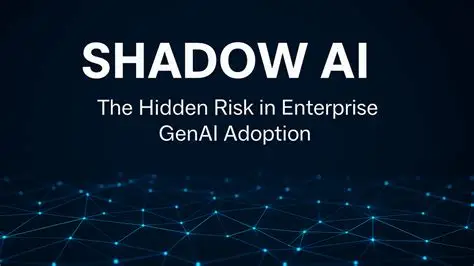
Shadow AI is quietly spreading through organizations of every size — and most leaders have no idea how deep the problem runs. While your IT team is focused on firewall rules and approved software lists, employees across departments are pasting confidential data into free chatbots, uploading internal documents to unvetted AI tools, and building entire workflows around models that have never passed a single security review. This isn’t a distant threat on the horizon. According to recent data, 98% of organizations already have employees using unsanctioned AI tools — and the average cost of a shadow AI data breach has now reached $4.2 million per incident. The question is no longer whether shadow AI exists inside your company. The question is what you’re going to do about it.
What Is Shadow AI and Why Is It Exploding in 2026?
Shadow AI refers to the use of artificial intelligence tools, platforms, and models by employees without the knowledge, approval, or oversight of their organization’s IT or security departments. Think of it as the next evolution of shadow IT — but with far higher stakes, because AI doesn’t just store data. It ingests it, learns from it, and sometimes feeds it into public training models with no way to pull it back.
The explosion is not hard to explain. A developer under deadline pressure can have a fully functioning AI agent up and running in an afternoon using a personal API key, a free framework, and a no-code interface. A customer service agent can paste a client complaint into ChatGPT at 3 PM and get a polished response back before 3:01. The tools are powerful, free or near-free, and require zero approval process. The problem is everything happening on the other side of that convenience.
The Scale of Adoption Is Staggering
A Microsoft study found that 75% of workers already use AI at work, with 78% of them relying on tools they sourced themselves rather than tools approved by their employers. Gartner predicts that by 2027, 75% of employees will acquire, modify, or create technology entirely outside IT’s visibility. And Deloitte’s 2026 State of AI in the Enterprise report found that while worker access to AI rose by 50% in 2025 alone, only one in five companies has a mature governance model to oversee how that AI is actually being used.
Meanwhile, nearly 47% of generative AI users access these tools through personal accounts — meaning enterprise monitoring tools, DLP policies, and access controls are entirely bypassed from the moment the employee logs in. It’s not malicious behavior in most cases. It’s just people trying to get their jobs done faster in a world where AI tools are everywhere and approval processes are slow.
Why Shadow AI Is More Dangerous Than Shadow IT Ever Was
Traditional shadow IT — a rogue Dropbox account, an unapproved Slack workspace — was bad. But shadow AI is a different beast entirely. When an employee installs unauthorized software, data might leave your perimeter. When an employee uses an unauthorized AI tool, data is actively ingested by a system designed to learn from inputs. That customer list pasted into a free chatbot may end up in the model’s training data. That proprietary code shared with an unvetted coding assistant may be reproduced in someone else’s suggestion six months later. There is no “undo.”
What makes it worse is detectability. Most AI platforms operate over HTTPS. Without SSL inspection — a control many organizations have not deployed — standard firewall rules and network monitoring cannot inspect the content of those interactions. From the outside, shadow AI traffic looks exactly like legitimate web browsing. Security teams are essentially flying blind.
“The most dangerous AI risk in 2026 is not an external attack — it’s internal AI governance failure: AI systems deployed without proper security controls, auditability, or access restrictions.” — JazzCyberShield Security Research, 2026
The Real Risks: Data Leaks, Compliance Failures, and Agentic Sprawl
The risks from shadow AI are not theoretical. They are happening now, in documented incidents, with documented financial consequences. Understanding the specific threat categories is the first step toward building a governance response that actually works.
Data Leakage: The Silent Exfiltration Channel
Every prompt sent to an unvetted third-party AI model is data leaving your environment. Research from IBM found that shadow AI-related breaches cost organizations an average of $670,000 more per incident compared to standard data breaches. A 2026 survey revealed that around 54% of shadow AI tools have been used to upload sensitive company data — including customer PII, financial records, and proprietary source code. The Samsung incident, in which three semiconductor engineers leaked proprietary source code, meeting transcripts, and chip yield test sequences through ChatGPT within a single month, remains the most cited example of exactly what unmanaged AI adoption can produce. The company’s initial reaction was an outright ban, which failed, as bans always do when organizations haven’t provided adequate alternatives.
Agentic shadow AI raises the stakes even higher. Unlike a single prompt-and-response interaction, an autonomous AI agent can chain tasks: summarize a document, cross-reference a database, email results to an external contact — all without human intervention at each step. Rogue agents inherit the permissions of whoever deploys them. If that developer has read access to the production database and write access to the customer email system, so does their unauthorized agent. The data doesn’t just leave in one burst — it leaks continuously, autonomously, and invisibly.
Compliance and Regulatory Exposure
The compliance landscape in 2026 is genuinely unforgiving. The EU AI Act’s cloud provisions came into force in March 2026, updated SEC cybersecurity disclosure rules now require near-real-time breach reporting, and GDPR Article 28 mandates documented data processing agreements with any processor handling personal data. Shadow AI violates all of these frameworks simultaneously, and most organizations don’t even know it’s happening.
A study found that 52% of firms say shadow AI complicates their regulatory compliance efforts, while nearly 44% have already faced compliance violations directly attributable to unauthorized AI use. Mimecast’s State of Human Risk 2026 report, based on responses from 2,500 IT security and IT decision-makers across nine countries, found that while 80% of organizations are concerned about sensitive data leaking through generative AI tools, 60% still have no specific strategy to address it. That awareness-without-action gap is precisely where regulators look when conducting audits.
Agentic Sprawl and the Invisible Infrastructure Problem
The newest frontier of shadow AI risk is what analysts are calling “agentic sprawl” — the proliferation of autonomous AI agents deployed without registration, governance, or audit trails. Shadow AI agents are the new shadow IT. Teams spin up agents using personal API keys, connect them to corporate data through unofficial MCP servers, and deploy them without any security review. These agents make API calls to model providers, connect to databases, invoke tools, and generate outputs — all of it invisible to the security team unless specific detection infrastructure is in place.
Organizations with strong AI governance and clear policies see 67% less shadow AI usage. Companies that invest in employee AI training experience 40% fewer security incidents. The path forward is not prohibition. It is governance that is fast enough to compete with the tools employees would otherwise find on their own. Visibility-first frameworks — detect all AI tools in use, classify them by data handling risk, restrict high-risk tools, and provide secure approved alternatives — are proving to be the most effective approach in 2026. Tools like Cloud Access Security Brokers (CASB) combined with browser-layer DLP, API gateway monitoring, and identity-based access controls give security teams the multi-layer coverage needed to actually see what is happening across the organization.
Frequently Asked Questions
What exactly is shadow AI and how is it different from shadow IT?
Shadow AI refers to the use of artificial intelligence tools within an organization without IT approval or security oversight — including chatbots, AI coding assistants, and autonomous agents. Unlike shadow IT, which involves unapproved software or devices, shadow AI actively processes and learns from the data fed into it, creating deeper and harder-to-reverse risks including data leakage into public training models, compliance violations, and autonomous actions taken without human review.
How widespread is shadow AI in today’s organizations?
According to multiple 2026 studies, the scale is enormous. A Gartner study found that 68% of employees use AI tools without IT approval. Separately, research indicates that nearly 98% of organizations have employees using unsanctioned AI tools. Around 47% of generative AI users access these tools through personal accounts that completely bypass enterprise controls. In some industries, shadow AI usage has grown as much as 250% year over year according to Zendesk’s 2026 CX Trends Report.
What is the financial risk of a shadow AI data breach?
The numbers are significant and growing. The average cost of a shadow AI data breach has reached $4.2 million per incident. IBM research found that shadow AI-related breaches cost an additional $670,000 more per incident compared to standard breaches. Organizations without governance frameworks also face regulatory fines under GDPR, the EU AI Act, and SEC disclosure rules — compounding the financial exposure well beyond the initial breach cost.
How can organizations detect shadow AI usage?
Effective detection requires a multi-layer approach. Cloud Access Security Brokers (CASB) can surface unsanctioned SaaS and AI applications. Network traffic analysis can identify unusual patterns consistent with AI API calls. Browser-layer DLP tools, like Microsoft Purview integrated with Edge for Business, can inspect AI prompts in real time. OAuth token monitoring can flag unauthorized integrations. Anonymous internal surveys also surface informal usage that technical tools may miss. No single tool is sufficient — the strongest programs combine all of these signals.
Should companies ban shadow AI tools entirely?
Outright bans consistently fail and often make the problem worse by driving usage to personal devices and cellular hotspots where visibility drops to zero. Organizations that simply block AI tools without providing approved alternatives see productivity drops and employee workarounds. The most effective strategy is to provide sanctioned enterprise-grade alternatives, establish clear usage policies, train employees on data handling risks, and implement monitoring that detects rather than punishes usage. Companies with clear AI policies report 67% less shadow AI usage than those without.
What is agentic shadow AI and why is it especially risky?
Agentic shadow AI refers to autonomous AI agents deployed by employees without security review or governance oversight. Unlike a single chatbot interaction, an AI agent can chain multiple tasks — accessing databases, sending emails, triggering API calls — entirely without human involvement at each step. These agents inherit the permissions of the user who deployed them, meaning they can access anything that user can access. Shadow agents leave no audit trail and can operate continuously, turning a single governance gap into an ongoing and scalable data exposure channel.
Conclusion
Shadow AI has moved from a theoretical governance concern to one of the most concrete and costly security risks organizations face in 2026. With 98% of companies already harboring unsanctioned AI activity, and breach costs averaging $4.2 million per incident, the window for treating this as someone else’s problem has closed. The answer is not to fight AI adoption — it’s to lead it. Organizations that build fast, low-friction AI governance frameworks, provide employees with approved alternatives, and invest in real detection capability will capture the productivity benefits of AI while protecting the data, compliance standing, and trust that their business depends on. The ones that wait will find out about their shadow AI problem the hard way. For deeper reading on AI governance frameworks, visit NIST’s AI Risk Management Framework, ENISA’s AI Security Guidelines, and Gartner’s AI Governance research for authoritative guidance on building responsible enterprise AI programs.